

Are Fragrance Oils Safe in Candles? What the Label Doesn't Tell You
Are Fragrance Oils Safe in Candles? What the Label Doesn't Tell You
The fragrance industry is not required to disclose every ingredient in a scent blend. In the United States, fragrance formulas are legally protected as trade secrets under the Fair Packaging and Labeling Act. That means a candle could list a single word, "fragrance," on its label and legally contain dozens of chemical compounds, some of which have been flagged by researchers as endocrine disruptors, respiratory irritants, and potential carcinogens. You had no idea, and neither did most people.
So when people ask whether fragrance oils are safe in candles, the honest answer is: it depends entirely on what is in that fragrance oil. Not all fragrance oils are created equal, and the difference between a non toxic formula and a problematic one is not visible on the shelf. This post breaks down exactly what to look for, what to avoid, and why the type of fragrance matters just as much as the type of wax.
What Exactly Is a Fragrance Oil?
A fragrance oil is a concentrated blend of aromatic compounds used to add scent to products like candles, soaps, and lotions. Unlike essential oils, which are derived directly from plant material through distillation or cold pressing, fragrance oils are typically formulated in a lab. That lab origin is not inherently a problem. In fact, it often allows for more consistent scent performance and a wider range of complex aromas that plants alone cannot produce.
The issue is not that fragrance oils are synthetic. The issue is what specific compounds are included in the formula, and whether those compounds are safe to inhale when burned.
The Difference Between Fragrance Oils and Essential Oils
Essential oils are single source extracts. Lavender essential oil, for example, comes directly from the lavender plant. It contains naturally occurring aromatic molecules like linalool and linalyl acetate. The process is relatively straightforward: plant material goes in, concentrated oil comes out.
Fragrance oils are formulas. A single fragrance oil might contain 30 to 80 individual chemical components, including both naturally derived isolates and lab created molecules. Some of those molecules are completely safe. Others, specifically certain phthalates, are not.
The fragrance oil vs essential oil debate in candles often misses this nuance. People assume essential oils are always safer, but that is not automatically true. Some essential oils can be irritating at high concentrations, and many perform poorly in candles due to low flash points. Meanwhile, a well formulated, phthalate free fragrance oil can burn cleanly and safely. The key is the formulation, not the category label.
What Are Phthalates and Why Do They Matter?
Phthalates are a class of chemical compounds commonly used as solvents and fixatives in fragrance formulas. They help scents bind to carriers and last longer. They are inexpensive and effective, which is why they became widely used across personal care products, plastics, and yes, candles.
The problem is the research. The National Institutes of Health and the Environmental Working Group have both flagged certain phthalates, particularly diethyl phthalate (DEP) and dibutyl phthalate (DBP), as potential endocrine disruptors. Studies published in peer reviewed journals have linked phthalate exposure to hormonal disruption, reproductive concerns, and developmental issues in children. The European Union has banned or restricted several phthalates in consumer products. The U.S. has been slower to regulate them in fragrances specifically.
When a candle containing phthalate laden fragrance oil burns, those compounds enter the air as part of the combustion process. You breathe them in. Over time, that exposure adds up.
The "Clean Fragrance" Marketing Problem
Here is where things get complicated. The term "clean fragrance" is not regulated. Any candle brand can use it. There is no third party certification required, no ingredient disclosure mandate, and no legal definition. Some brands use it honestly to describe genuinely phthalate free formulas. Others use it as a marketing shortcut with no meaningful formulation change behind it.
This is why reading labels is not enough. You need to look for specific claims: phthalate free, and ideally a brand willing to explain what that means in practice.
What Makes a Fragrance Oil Actually Safe?
Safe fragrance oil in candles comes down to a few specific factors. Each one matters independently, and together they determine whether a scented candle is genuinely non toxic or just marketed that way.
Phthalate Free Formulation
This is the non negotiable. A fragrance oil formulated without phthalates eliminates the most well documented class of problematic compounds associated with candle fragrance. When a brand commits to phthalate free fragrance, it means the fixatives and solvents used in the formula come from a different, cleaner source.
At MBur, every candle is made with phthalate free fragrance oils. If you want to go deeper on how phthalate free fragrance differs from essential oil formulas and what the full non toxic checklist looks like, the breakdown in what makes a candle non toxic covers exactly that.
IFRA Compliance
The International Fragrance Association (IFRA) publishes standards for safe fragrance use across product categories, including candles. IFRA compliance means a fragrance formula has been benchmarked against their list of restricted and prohibited substances. It is not a perfect system, but it provides a meaningful baseline. Reputable fragrance suppliers test for IFRA compliance and provide documentation.
No Chemical Dyes
Color is often added to candles using synthetic dye compounds. When those dyes burn, they contribute to the combustion chemistry and can release additional compounds into the air. A candle with no chemical dyes reduces that variable entirely.
Wax Type Matters Too
The fragrance oil does not burn alone. It burns inside a wax carrier, and the wax contributes its own combustion byproducts. Paraffin wax is a petroleum byproduct. It releases benzene, toluene, and formaldehyde when burned, full stop. No fragrance oil, however clean, fully offsets what the wax itself is releasing.
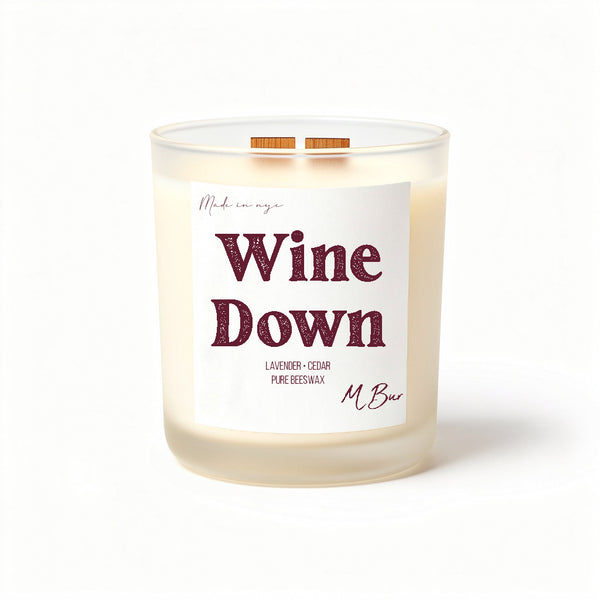
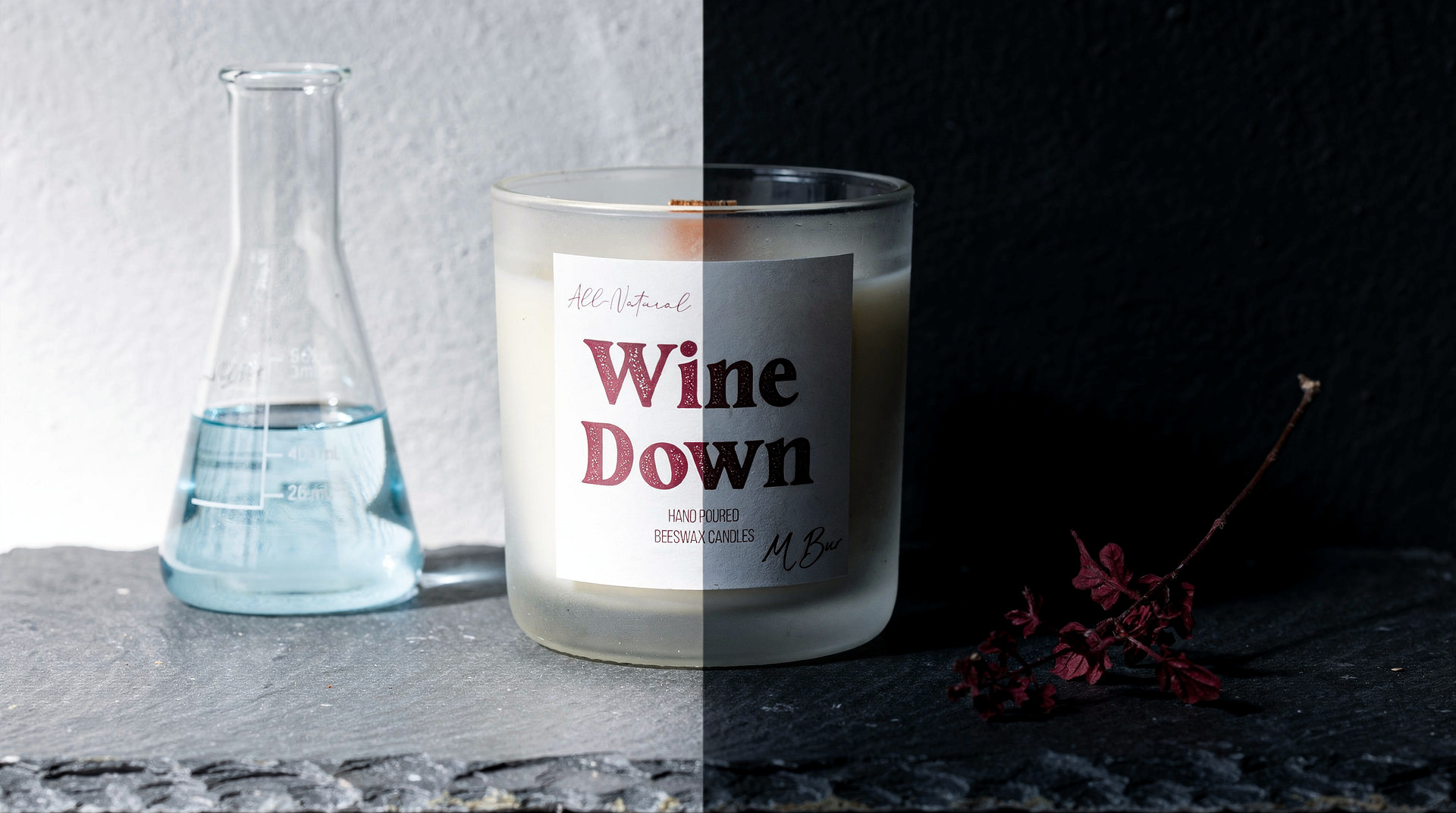
Beeswax is the cleanest burning candle wax available. It has a higher melting point than any other candle wax, burns longer, and produces minimal soot. When you combine beeswax with a phthalate free fragrance oil, you have a genuinely clean burning candle. The Wine Down beeswax candle, for example, uses exactly this combination: 100% beeswax and phthalate free fragrance. Lavender, chamomile, sage, cedar, and sandalwood. Starting at $20 for the 20 hour size.
"A lot of other candles tend to give me headaches, but this one was a total game changer. I was able to enjoy the calming aroma without any discomfort." Nicole D., Sunday Reset Candle
That experience Nicole describes is not accidental. It is the direct result of what is not in the candle.
Fragrance Oil vs Essential Oil in Candles: Which Is Actually Better?
The Case for Essential Oils
Essential oils are transparent. You know the source. Lavender oil contains lavender compounds. Eucalyptus oil contains eucalyptus compounds. For people with specific sensitivities or preferences for plant derived ingredients, essential oils offer that clarity.
Some essential oils also carry documented aromatherapy benefits. Lavender has well studied calming properties. Eucalyptus has documented effects on respiratory clarity. Peppermint has been studied for alertness and focus.
The Case for Phthalate Free Fragrance Oils
Fragrance oils can achieve scent complexity that essential oils cannot. A candle that smells like ripe citrus over a base of warm amber and tea requires a formula, not a single plant extract. That complexity is not a shortcut. It is a craft.
Fragrance oils also tend to perform better in candles specifically. Many essential oils have low flash points, meaning they can burn off before the candle wax even melts properly, resulting in weak or inconsistent scent throw. A well formulated fragrance oil is designed for candle performance: it binds to the wax, releases gradually with heat, and fills a room consistently.
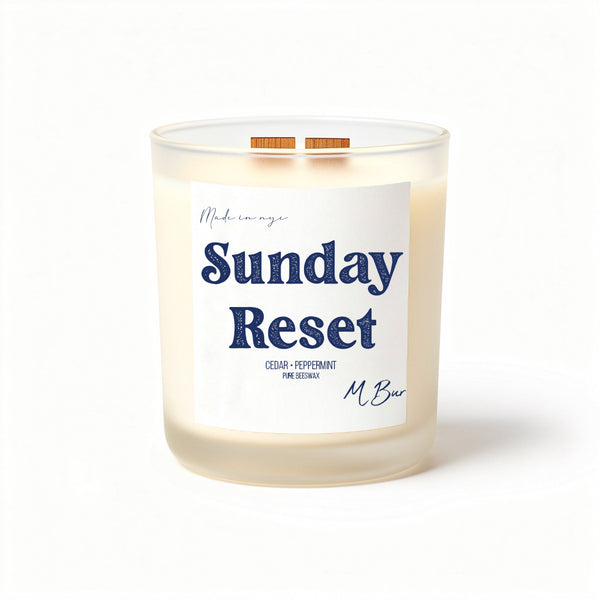
The Sunday Reset beeswax candle is a good example. The scent profile, eucalyptus, peppermint, and cedar, would be extremely difficult to replicate with essential oils alone at candle safe concentrations. Phthalate free fragrance oil makes that scent possible without the safety trade off. Starting at $20 for the 20 hour size.
The Honest Verdict
Neither category is automatically safer than the other. An essential oil candle in paraffin wax is not safer than a phthalate free fragrance oil candle in beeswax. The full picture requires looking at wax type, fragrance formulation, dye content, and wick material together.
The Wick Variable Nobody Talks About
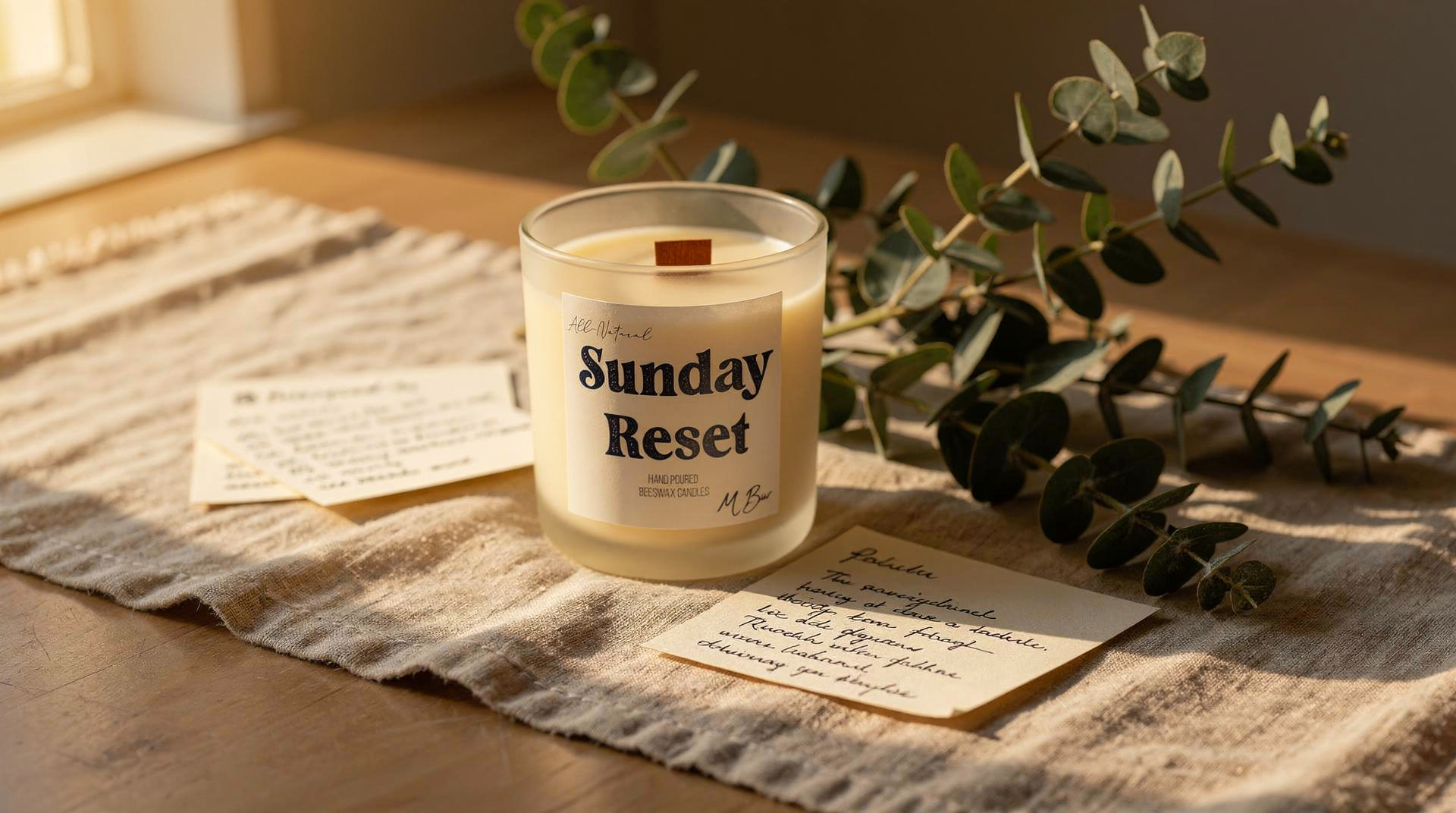
Wick composition affects what burns along with the wax and fragrance. Cotton wicks are generally safe. Wooden wicks, which MBur uses across the entire candle line, are also clean burning and add a soft crackling sound during burn. The wick type to avoid is any wick with a metal core. Metal core wicks can release heavy metal particulates into the air when burned. If you cannot identify the wick material, that is a reason to ask.
Practical Checklist: How to Evaluate a Candle's Fragrance Safety
Before purchasing any scented candle, run through this list:
- Is the fragrance oil explicitly phthalate free? Look for that exact claim, not just "clean fragrance."
- What is the wax base? Paraffin is a red flag regardless of fragrance quality.
- Are there chemical dyes? No dye is always better than synthetic dye.
- What is the wick made from? Avoid metal core wicks.
- Does the brand disclose fragrance sourcing? Transparency matters more than marketing language.
MBur candles check every item on that list. The full candle collection is 100% beeswax, phthalate free fragrance, wooden wick, and no chemical dyes.
"I instantly notice the difference in the air quality, in comparison to the Bath and Body scented candles. I love Bath and Body's candles but I acknowledge that it caused a slight headache and other minor respiratory discomfort." Jason H., Sunday Reset Candle
Frequently Asked Questions
Are fragrance oils toxic when burned?
It depends on the formula. Fragrance oils that contain phthalates or other restricted compounds can release harmful particulates when burned. Phthalate free fragrance oils formulated for candle use and burned in a clean wax like beeswax are not considered toxic.
Are essential oil candles always safer than fragrance oil candles?
No. Wax type, dye content, and wick material all factor into candle safety. An essential oil candle in paraffin wax with synthetic dyes is not inherently safer than a phthalate free fragrance oil candle in beeswax. Evaluate the full ingredient picture, not just the fragrance type.
What does phthalate free actually mean in a fragrance oil?
It means the fragrance formula was developed without using phthalate compounds as solvents or fixatives. Phthalates like DEP and DBP are commonly used in fragrance because they are cheap and effective, but they are also linked to endocrine disruption. Phthalate free formulas use alternative fixatives to achieve the same performance without those compounds.
How do I know if my current candles have phthalates?
You often cannot tell from the label. Most candles list "fragrance" as a single ingredient without further disclosure. The safest approach is to buy from brands that explicitly state their fragrance oils are phthalate free and can explain their sourcing. If a brand cannot answer that question, assume they have not checked.
Can I use fragrance oil candles around pets or kids?
Phthalate free fragrance oil candles in beeswax are a significantly better choice than paraffin or blended wax candles with undisclosed fragrance, particularly in spaces shared with children or pets. Always ensure ventilation and never leave candles unattended. For more on candles around animals, see our posts on candle safety for cats and candle safety for dogs.
The Bottom Line
Fragrance oils are not inherently dangerous. Toxic fragrance oils are dangerous. The distinction is specific and it matters. A candle made with phthalate free fragrance oil in 100% beeswax with a wooden wick and no chemical dyes is one of the cleanest burning scented candles you can buy.
Shop the full MBur beeswax candle collection
What buyers say:
Related reading:

