

Frosting on Soy Wax: Why It Happens and How to Fix It
That chalky white film creeping across your soy candle is called frosting. It shows up on the surface and along the glass, and it looks like frost or a dusting of snow. Most people see it and assume the candle went bad, got dusty, or grew mold.
None of that is true. Frosting is a natural trait of pure plant wax, and it says something good about what is inside the jar. If a fresh-smelling, clean-burning candle is what you are after, MBur's pure beeswax candles skip the frosting problem entirely and burn without paraffin soot. But before you toss that soy candle out, it helps to know what is actually going on.

Frosting is a badge of purity, not a defect
Here is the part that trips people up. A perfectly smooth, glassy soy candle is often the suspicious one. Frosting shows up because the wax is genuinely plant-based.
Many "flawless" commercial soy candles hide a secret. They blend in paraffin or chemical hardeners to force that smooth finish. So the white bloom you are frowning at is proof your candle is real soy.
What frosting actually is
Frosting is a mild form of something called polymorphism. That word just means the wax can settle into more than one crystal shape at once.
Soy wax is made of long-chain fatty acids. As the wax cools, those acids shift back into stable crystal patterns. Some form on the surface. They look white and flaky, like a thin frost.
Paraffin does not do this. It is a heavily refined petroleum wax with a uniform, inert structure. Soy is natural and a little wild by comparison.
Why your candle frosted after you bought it
You did nothing wrong. Frosting is not always there from day one. It can appear weeks later, and the reason is temperature.
Candles hate sudden swings. A jar that ships through a hot truck, then sits in a cold room, gets a shock. The crystals migrate and grow. That is secondary frosting, and it happens after the candle is already made.
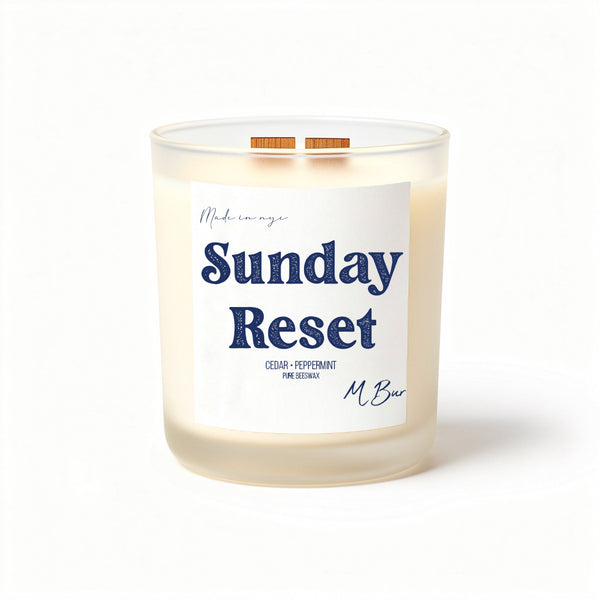
This is also why MBur skips the whole issue. Our candles are 100% beeswax, and beeswax does not bloom the way soy does. If you want a fresh-smelling room without babysitting the temperature, a scent like Sunday Reset gives you eucalyptus, clove, cedar, patchouli, and vanilla in a wax that stays clean-looking through shipping and seasons.
"I absolutely love these candles! I instantly notice the difference in the air quality, in comparison to the Bath & Body scented candles. I love Bath & Body's candles but I acknowledge that it caused a slight headache and other minor respiratory discomfort. Awesome products. Totally addicted." Jason H.

Does frosting hurt the candle at all?
No. This is the good news you came for.
Frosting is purely cosmetic. It has zero effect on burn time. It does not change the scent throw. The candle is just as safe and just as strong.
The surface crystals sit on top. They do not block the fragrance oils from diffusing into the air. Your room will smell exactly as it should.
So if you already own a frosted soy candle, keep burning it. Nothing is wrong.
How to prevent frosting when you make candles
Maybe you pour your own. If so, you cannot erase frosting from pure soy, but you can calm it down. The trick is controlling how the wax cools.
Fast, uneven cooling is the enemy. Slow and steady wins here. Below are the steps makers use most.
Control your temperatures
Heat soy wax to about 170°F to 185°F. Do not overheat it. Add your fragrance oil around 155°F to 165°F and stir gently.
Pour into containers around 120°F to 140°F, or close to the wax's cloudy congealing point. Pouring cooler slows crystal growth.
Warm your jars first
Cold glass shocks hot wax. Preheat your jars to about 30°C to 40°C before pouring. This gives a smoother start.
Cool slowly in a stable room
Keep your workspace steady at 68°F to 77°F. Let candles cure 7 to 14 days away from drafts and cold surfaces. Do not set them near a window or vent.
Avoid a few common mistakes
Do not pour into ice-cold jars in a drafty room. Do not whip the wax hard, since agitation speeds up crystals. Do not overload the fragrance oil, because too much destabilizes the wax.
Dark dyes do not cause frosting. They just make the white crystals pop against the color, so they look worse than they are.

The easier fix: skip soy's frosting entirely
Chasing a zero-frosting soy candle is a lot of work. Many indie makers now just market the texture instead. That is honest, and it works.
But if the white bloom bugs you and you want a candle that stays clean-looking, beeswax is a strong answer. It has the highest melting point of any candle wax, so it burns slow and steady. Our Room Service candle carries saffron, white tea leaves, purple peonies, orchid, tobacco, vanilla, almond milk, and tonka bean, and it holds a smooth finish through shipping and seasons.
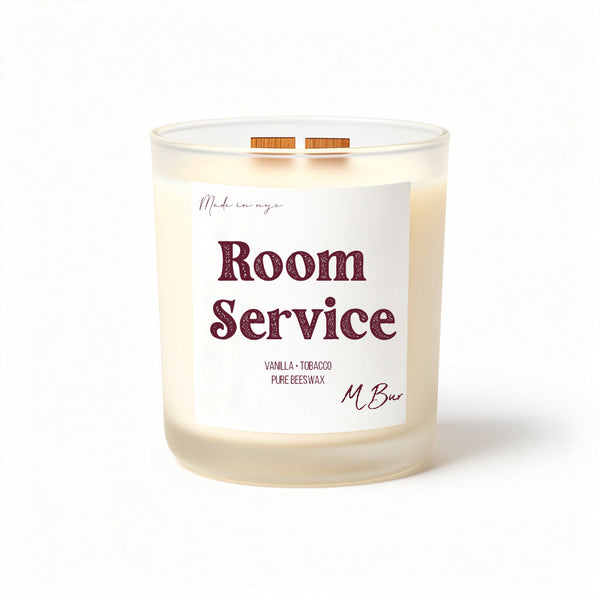
Beeswax is a single-ingredient wax, not a blend. It burns clean with no paraffin soot. The scent stays true, and the jar keeps looking the way it did on day one.
Frequently asked questions
What is frosting on soy wax candles?
It is a natural white crystalline bloom that forms as the wax's fat molecules recrystallize on the surface and sides. It is harmless and common in pure soy. If you would rather avoid it, our beeswax candle collection does not frost this way.
Does frosting affect the way a candle burns or smells?
No. Frosting is entirely cosmetic and does not change burn time, scent throw, or safety. A frosted soy candle burns and smells just fine.
Why does pure soy frost while paraffin does not?
Soy is made of natural fatty acids that shift back into stable crystals over time. Paraffin is heavily refined and has a uniform, inert structure. Beeswax also stays smooth, which is why our Sunday Reset candle keeps a clean look.
Can temperature changes cause frosting after a candle is made?
Yes. Sudden room swings, drafts, or moving a candle between hot and cold spots can trigger new crystal growth. Store your candles somewhere stable.
How do I minimize frosting when making candles?
Preheat your jars, pour at lower temperatures, and let candles cool slowly in a draft-free room. For a wax that avoids the issue, start with the beeswax collection.
The takeaway
Frosting on soy wax is a sign of a genuine plant-based candle, and it never hurts how the candle burns or smells. You can soften it with careful pouring, or you can sidestep it with beeswax that keeps a smooth finish. Loved by hundreds of five-star reviews, MBur candles burn clean with no paraffin soot and no toxic fragrance.
For a candle that stays looking as good as it smells, start with the Room Service candle, our bestseller, available in the 49-hour size at $32 up to the 80-hour size at $65.

