
A parked car climbs to 120°F to 140°F on an ordinary day. Three of the four common waxes give up in that range. Beeswax melts around 144°F to 147°F.
Shop the candles
Every wax has a number
Melting point is a physical property, not a quality signal. It varies more between waxes than most people realize. Here is where each one sits against that 120°F to 140°F cabin range.
| Wax | Melting point | Against a hot car |
|---|---|---|
| Coconut | Around 100°F to 110°F | Melts first, often on a merely warm day |
| Soy | Around 120°F to 125°F | Sits right at the bottom of the range |
| Paraffin (container grade) | Around 120°F to 140°F | Softens across most of the range |
| Beeswax (what we pour) | Around 144°F to 147°F | Clears the cabin range in most conditions |
The spread is the whole story. A soy candle starts softening at about the temperature your car reaches after an hour on a pleasant day. Beeswax needs another twenty degrees on top of that. Most car interiors never get there, even in summer, though a dashboard in direct sun still can.
The number that decides this is not on your weather app
A parked car does not sit at the outside temperature. It climbs past it, faster than almost anyone expects. Ten minutes in a lot on a mild spring afternoon puts the inside about twenty degrees above the air outside. An hour of errands roughly doubles that gap.
Every candle wax has a specific temperature where it stops being solid. Those numbers sit much closer to the inside of a warm car than to the weather outside it. Three of the four common waxes fall below the line. One clears it, which is a large part of why we pour 100% beeswax candles and nothing else.
How hot a parked car actually gets
Research on vehicle heating, most of it done for child and pet safety, gives fairly consistent numbers. A car parked in the sun gains roughly nineteen degrees Fahrenheit in the first ten minutes, about thirty-four degrees in half an hour, and around forty-three degrees after a full hour. The curve is steepest at the start, so a quick stop is not as safe as it feels.
Run those numbers against an ordinary day. Eighty degrees outside puts the cabin near 123°F after an hour of shopping. Ninety degrees outside puts it around 133°F. Cracking the windows changes this far less than people assume, shaving only a few degrees off the total. Direct sun on a dashboard or a seat pushes the surface temperature higher still, well past what the air in the cabin reads.
So the working range for a candle sitting in your car on a warm day is roughly 120°F to 140°F, and on a dashboard in full sun, higher.
Why beeswax sits so much higher
Beeswax has the highest melting point of the common candle waxes. It is a denser, harder wax with a tighter molecular structure. That same property makes it burn slower and last longer per ounce than soy or paraffin. It is also the oldest candle material we have, going back to about 5,000 BCE, and it is a byproduct of honey production.
This is why the MBur line ships year round with no seasonal holds. A delivery truck in August runs hot, and beeswax handles it.
What to watch for on a label
One honest caveat, because you will see it claimed otherwise. Makers can raise the melting point of softer waxes with additives, hardeners, and polymer blends, so a paraffin blend is not automatically stuck at 120°F. What that means is that "soy blend" or "coconut blend" on a label tells you very little about how it behaves in a hot car, since the composition is undisclosed. The word "beeswax" is not regulated in the US either, so a paraffin blend with 1% beeswax can be labelled beeswax. A candle stated as 100% beeswax gives you a number you can predict. Ours is 100%, single ingredient, never a blend.
What actually goes wrong when one melts
The obvious failure is the messy one. A fully liquefied candle can overflow the vessel on a turn. Wax that soaks into upholstery or carpet is a genuinely difficult repair, since scraping and heat-lifting only gets most of it out.
The failure people miss is quieter and more common. Even when the wax stays in the jar, a wick that was centered in solid wax can drift while the wax is liquid and set off-center once it cools. From then on the candle burns lopsided, tunnels down one side, and leaves a hard ring of unused wax that will not melt down. It looks fine on the shelf and never burns properly again.
Fragrance takes a hit too. Scent compounds are volatile, and repeated heat cycling in a hot car drives some of them off before you have lit the thing once. A candle that cooked in a back seat for a summer afternoon often throws noticeably weaker for its whole life.
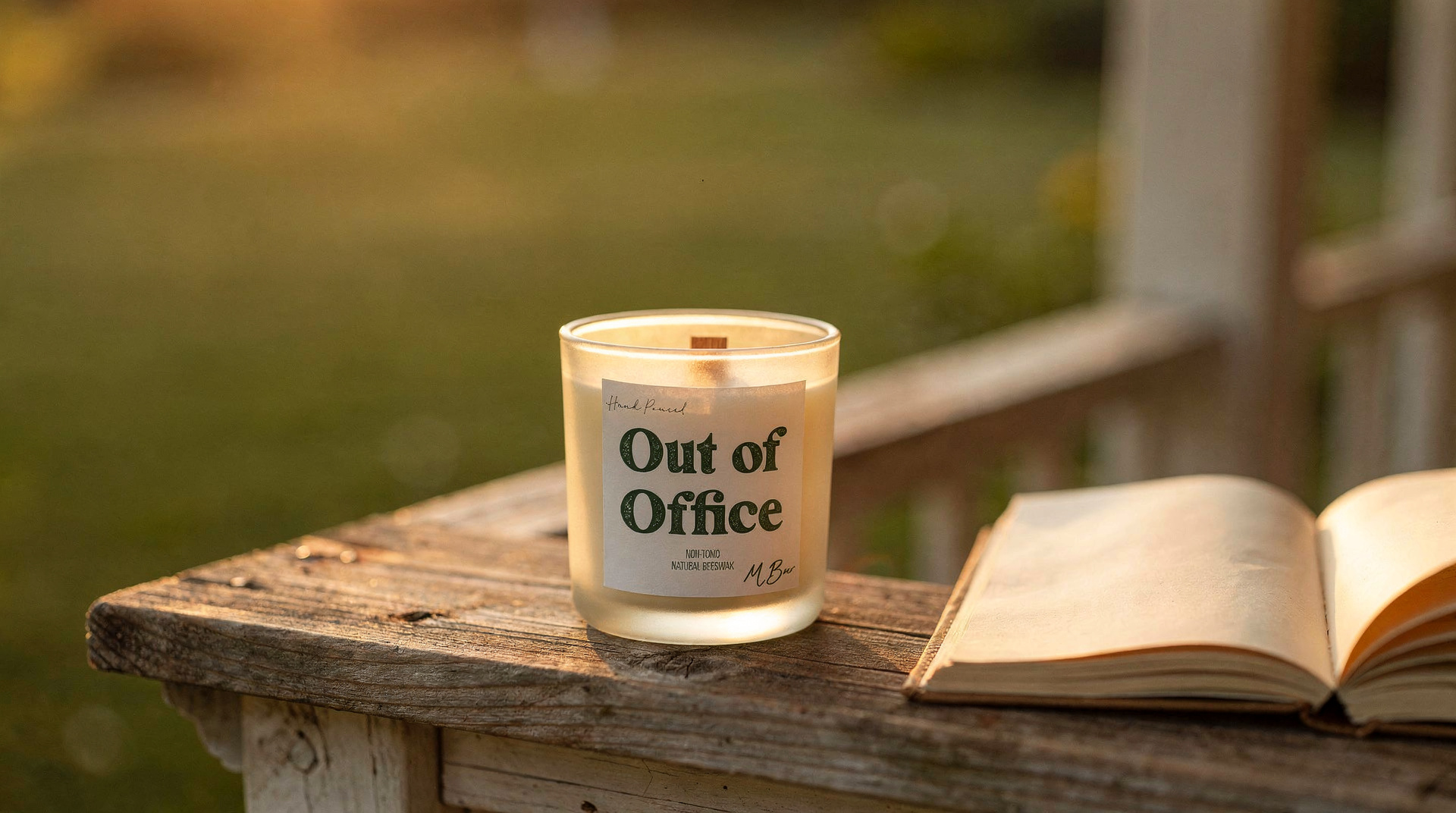
If yours has already been sitting in the car
Bring it inside. Put it on a level surface away from a window and leave it alone until it is completely back to room temperature. That takes longer than it looks, often several hours for a full jar. Moving it while the center is still soft is what turns a recoverable candle into a permanently crooked one.
Once it is cold, check the wick. If it is still upright and centered, the candle is fine and you can light it normally. If it has leaned or migrated toward one wall, you can sometimes correct it by warming the top layer gently with a hair dryer on low, nudging the wick back to center, and letting it reset flat. If the wick has set fully off-center, or wax escaped the vessel, the candle is not worth the fire risk of trying to save.
Keeping it from happening at all
- Make the candle your last stop. Everything else here is damage control compared with simply not leaving it in the car for an hour.
- When that is not possible, use the footwell behind a front seat. It is the coolest spot in the cabin, out of direct sun and low down where the hottest air is not collecting. The trunk works too on most days.
- Avoid the dashboard, the parcel shelf, and any seat taking full sun. Surface temperatures there run well above what the cabin air reads.
- Keep it in its box or bag for the shade, and keep the lid on if it has one. Our 80-hour size includes a lid, which keeps grit out of the surface if the top layer does soften at all.
Which candle to buy if this keeps happening
If you buy a candle in the middle of a long errand run rather than on the way home, the wax is the only thing that will save you. 100% beeswax clears the temperature range a car actually reaches. Every candle below is the same wax, so all of them handle the drive the same way.
The obvious pick for the shopping-bag crowd, and our strongest throw for large or open rooms. You will love this if you love a warm floral that fills a whole floor.

Summer road trip candle that survives the trip. You will love this if you love tropical scents without the sunscreen sweetness.

Our number one seller, and the one people buy as a gift then keep. You will love this if you love a hotel lobby vanilla with a little smoke behind it.

Cafe-window warmth for fall and winter drives. You will love this if you love warm spice without anything cloying.
Specs
| Wax | 100% pure beeswax, single ingredient, never a blend |
|---|---|
| Wick | Untreated wooden wick that crackles |
| Fragrance | Phthalate-free non-toxic fragrance oils |
| Burn time | 40 hours ($32) or 80 hours ($65, includes a lid) |
| Dyes | None. No synthetic dyes. Hand-poured in New York City |
Free shipping at $65.
Frequently asked questions
At what temperature does a candle melt?
It depends entirely on the wax. Coconut goes around 100°F, soy around 120°F, container paraffin between 120°F and 140°F, and beeswax around 144°F to 147°F. A parked car in the sun commonly reaches 120°F to 140°F, which is above three of those four numbers.
Can I save a candle that melted in my car?
Often, yes. Let it cool completely on a flat surface, then check whether the wick is still centered. A centered wick means the candle is fine. A wick that set against one wall will tunnel and is better replaced than burned.
Does cracking the windows help?
Barely. Studies on vehicle heating consistently find that leaving windows partly open reduces the interior temperature by only a few degrees, which is not enough to move a soy or coconut candle out of its melting range.
Is it safe to ship candles in summer?
Beeswax handles it, since delivery trucks generally run below its melting point. Soy and coconut candles are the ones that arrive softened in July, which is why some brands pause shipping or add cold packs in hot months.
Will a beeswax candle ever melt in a car?
In extreme conditions it can soften, particularly on a dashboard in direct summer sun where surface temperatures exceed cabin air by a wide margin. Beeswax clears the normal range rather than every possible one, and the footwell rule still applies.
What customers say
Want a candle that survives the drive home?
100% beeswax melts around 144°F, above what a car cabin normally reaches. Same wax in every scent.
Shop all candles